Localized termite eradication serves properties where colonies remain isolated within specific structural components rather than distributed across the entire framing envelope. In multi-unit properties in Koreatown or…
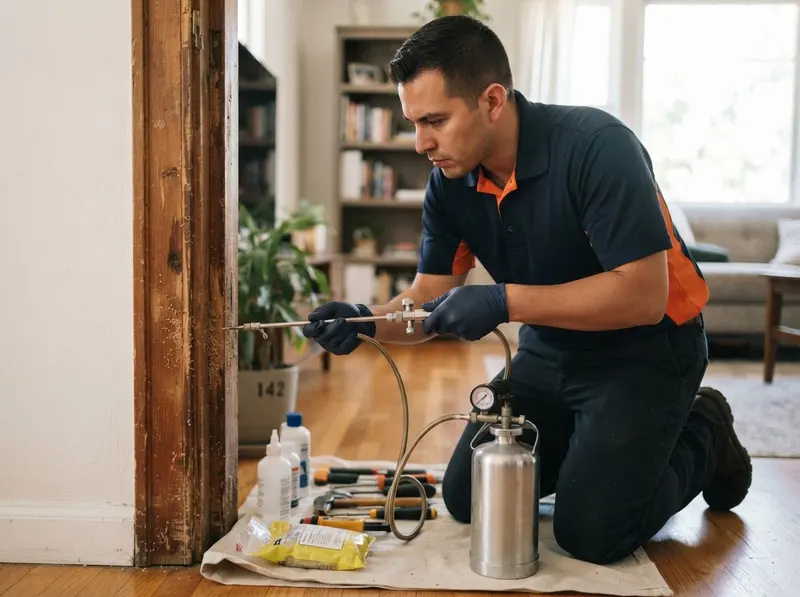
Localized termite eradication serves properties where colonies remain isolated within specific structural components rather than distributed across the entire framing envelope. In multi-unit properties in Koreatown or historic hillside bungalows across Silver Lake and Echo Park, whole-structure tent fumigation often presents severe logistical obstacles, including mandatory multi-day tenant displacement and complicated gas clearances governed by the California Structural Pest Control Board. For targeted infestations identified before swarmers compromise inaccessible wall voids, precision drill-and-inject localized treatment provides an exact solution. Technicians use acoustic listening tools and high-resolution optical scopes to identify active gallery networks inside the lumber. Liquid or expanding foam termiticides registered by the California Department of Pesticide Regulation and evaluated under EPA pesticide programs are then injected at 30 to 50 PSI straight into the nesting galleries. This pressure forces active ingredients directly into contact with the reproductive cast and worker termites, stopping structural degradation immediately without requiring occupants to vacate the premises.
Selecting spot treatment requires a clear understanding of structural trade-offs. Spot treatment delivers immediate knockdown for verified local infestations, yet it cannot eliminate hidden colonies nested behind impenetrable plaster, firewalls, or deep inside vaulted ceiling framing common in mid-century architecture throughout Sherman Oaks and Encino. If termite fecal pellets, known as frass, appear strictly along an exterior rafter tail or a single door casing, localized treatment isolates the hazard cost-effectively. However, if visual kick-out holes appear across three or more non-adjacent rooms, or if swarmers emerge simultaneously from attic purlins and basement subflooring, localized intervention leaves concealed satellite nests untreated. In those severe cases, full-envelope structural treatments or heat remediation guided by UC Statewide IPM Program protocols may be required. DiamondEdge Pest Defense conducts thorough exploratory checks of crawlspaces, attics, and exterior perimeters to verify whether timber damage is isolated before initiating injection.
Microclimates across Los Angeles directly dictate timber susceptibility and treatment design. Coastal marine layers rolling into Venice and San Pedro elevate ambient humidity, slowing wood drying times and creating ideal entry points for Incisitermes minor along damp exterior fascia boards. Conversely, prolonged inland heat cycles near the Sepulveda Basin Recreation Area desiccate exposed roof sheathing, driving swarmers deep into shaded interior attic joists and framing plates. Building codes enforced under the Los Angeles Department of Building and Safety require that repaired framing retains load-bearing capacity. When galleries compromise structural margins, treatment must be coupled with engineered timber sistering. Furthermore, properties near dense native flora, such as the chaparral surrounding Griffith Observatory and Elysian Park, face high annual swarming pressure from wild colonies. Applying surface penetrants containing disodium octaborate tetrahydrate, as outlined by the USDA Forest Products Laboratory, creates an enduring protective barrier that prevents emerging alates from re-infesting exposed architectural timbers.
DiamondEdge Pest Defense operates with rigorous execution standards to prevent call-backs. Standard procedures follow four sequential steps: 1. Complete acoustic and visual sounding of the affected framework to pinpoint exact gallery depth. 2. Boring precise 1/8-inch access holes into the wood grain along the termite run at 6-to-10-inch intervals, following structural recommendations from the Wood Products Council. 3. Injecting high-residual non-repellent formulations or pressurized botanical pyrethrins directly into the heartwood galleries to secure total colony transfer. 4. Sealing all drill penetrations with matching wood dowels and applying topical borate barriers to unpainted structural members. Every treatment complies with occupational standards defined by OSHA regulations and waste handling guidelines enforced by the Los Angeles County Household Hazardous Waste program. Pricing remains fully transparent: while the minimum service call is $250, comprehensive localized programs typically scale based on access requirements and linear footage of infested wood.
Every job gets a firm, written price after a free on-site visit.
For standards, safe disposal, and service guidance on pest control services in Los Angeles, CA, useful references include U.S. EPA, ENERGY STAR, U.S. Dept. of Energy, Consumer.gov, U.S. Census Bureau, and Google Maps. General consumer and small-business resources are available from USA.gov, Better Business Bureau, FTC Consumer Advice, U.S. Small Business Administration, and Ready.gov.
Tell us about your drywood termite spot treatment job in Los Angeles and we'll send a clear, written quote, usually the same day.
 DiamondEdge Pest Defense